
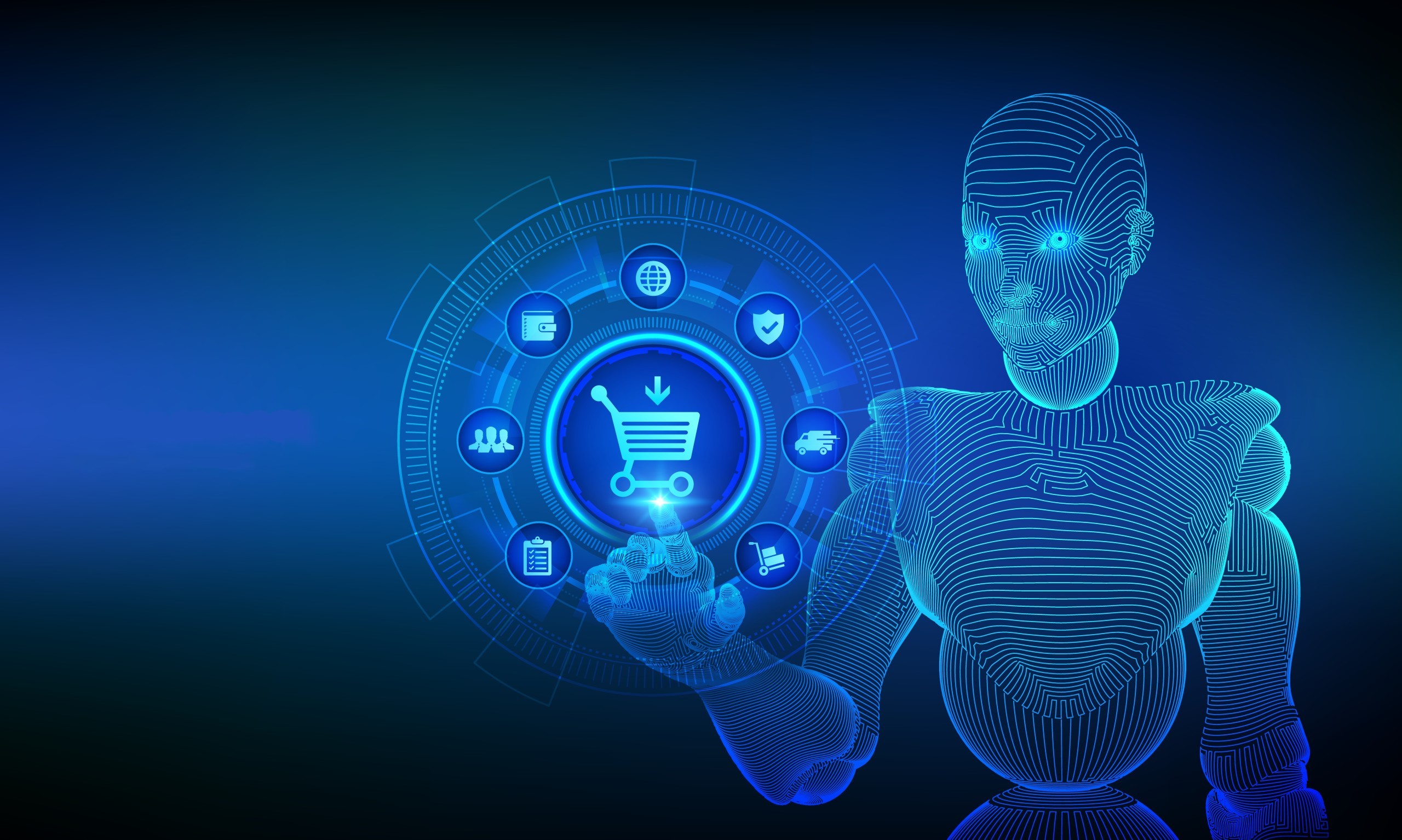
The majority of physical stores are now going online, according to 2024 trends. E-commerce has played a significant role in this change. One of the most innovative industries, e-commerce, has given entrepreneurs and startups a new avenue for company innovation. Have you ever considered the use of AI in online shopping? This will undergo a significant change, incorporating same-day delivery, mobile-friendly websites, and user-specific product recommendations. According to research and statistics, artificial intelligence (AI) in e-commerce is enabling businesses to compete at their highest level.
The majority of companies concur that e-commerce will increase by 93% in the future. The majority of companies and organizations have successful development plans and a specialized e-commerce staff using generative AI. AI for e-commerce is revolutionizing how businesses handle online use and is transforming the majority of enterprises and organizations with AI technology. AI is becoming more and more prevalent across all businesses, and it will revolutionize the e-commerce sector. Let’s examine AI’s potential in the e-commerce sector.
Understanding AI in E-commerce
AI has now been introduced in the e-commerce industry and has revolutionized the shopping experience for users. In simple terms, AI in e-commerce is the integration of AI technology in the e-commerce business that handles online retail operations using an e-commerce website or application. AI handles different tasks like product recommendation, customer service, and inventory management, and also generates creative marketing strategies.
AI has been beneficial to online stores as it offers personalized shopping experiences to customers, chatbots that give instant replies to queries, and detects fraudsters with ease with the help of a pattern recognition algorithm.
Future of AI in E-commerce
E-commerce in AI is now taking a place in the online shopping industry and is evolving consumer demand. AI trends in online shopping are creating a good opportunity for businesses to grow with AI in mobile commerce as well. The following are some of the future aspects of AI in e-commerce that are going to integrate with AI development services.
1. Personalized Recommendations
For e-commerce stores, AI offers users personalized product recommendations that help the business to get to the next level. AI analyzes the customer data and their purchasing behavior based on browsing history, which provides hyper-personalized product recommendations. According to the research, it has been seen that more than 80% of customers repurchase the brand with personalized product recommendations. This likely helps the business grow and makes customers of the brand.
2. Product Search with AI-Powered Search Algorithm
The most common issue that plagues most e-commerce websites is the search algorithm. When a customer searches for a particular product, but cannot find the exact match in the search bar, and cannot see the results. This is a drawback that leads to a loss of customers. Hence, to overcome this, AI-powered search algorithms work to get the best search terms. This can be done in e-commerce development using AI for a better user experience. With AI in e-commerce, it provides sophisticated search recommendations to users that help customers get the exact match. This gives relevancy in searching for products for customers and gets the exact match they are looking for. Rather than searching with specific brands, customers can even search with current trends and styles
3. Virtual Assistants or Chatbots
Instant reply to customers creates a positive impact on customers. Hence, chatbots play an important role in creating a positive impact on customers. Chatbots act as a virtual assistant that supports natural language processing. They provide personalized customer support to the users, understanding their context of conversation. For example, they can answer the queries of users, recommend products, cancel orders, and track the delivery.
4. Improved Inventory Management
With the help of purchasing history & predictive analytics, AI can help in inventory management. For retailers, integrating with AI can help to optimize the supply chain that ensures the right amount, right product, and right purchase. It helps to adjust to the customer’s requirements and the current trend in the market, considering the operations and minimizing costs. Considering the future of the market, it will help retailers to avoid overstocks, reducing inefficiencies.
5. Efficient Delivery
AI also helps in managing the logistics part. It helps to predict the fastest and most efficient delivery routes that give faster delivery. For a long-term customer to stay with your business, it needs to be fulfilled with faster delivery and fewer errors, giving a better overall experience. AI in e-commerce is a powerful tool that gives faster fulfillment of customers’ requirements. In turn, it also gives a simple, personalized & intuitive shopping experience to the customers that makes the business stand out in the marketplace.
6. Predictive Analytics
Prediction is a term that helps you to predict the future and what will be needed. Similar is the case with e-commerce. AI in eCommerce helps to do predictive analytics about identifying customers’ needs, current purchasing trends, customer purchasing behavior, etc. This is a valuable tool for businesses to understand the personalized requirements of the audience and also helps to determine their requests.
Application of AI in E-commerce
AI in e-commerce is providing a tailored solution for business making it more personalized, efficient & most importantly, responsive to users.
Here are some examples that one can have with custom eCommerce app development.
- Enhanced Visual Searching: One of the advanced e-commerce app features using AI is visual searching. This allows users to upload photos in the search bar and get the exact match from the store. This feature is helpful for industries like fashion, home decor, etc. It helps sellers know exactly what they are looking for without worrying about product name or category.
- Augmented Reality Integration: AR with AI is an outstanding combination that helps customers enable virtual trials on products like eyeglasses, furniture, etc. For example, if a user is looking for a specific pair of eyeglasses, then using AR, they can see the look and fit of the glasses on their face using AR technology. Also in the case of furniture, customers can view at ease how the item will look in a particular corner, how much space it will occupy & can buy it with confidence.
- Voice Recognition: With the e-commerce app development services, businesses can integrate voice commands in their e-commerce website or application. This gives a hands-free option for users to search for a particular product and get the exact results.
Conclusion
Integrating AI using e-commerce mobile app development is going to be a boon to the online industry. The reason behind this is simple. It will provide faster and more efficient solutions that are less likely to make errors like humans. For a business to stay ahead of the competition, an e-commerce app development company helps to integrate advanced AI into your application. AI-powered e-commerce apps involve searching, storing, logistics, payment systems, etc.
However, incorporating AI technology into the e-commerce strategy helps to build a successful business, in turn increasing customer retention. The future of AI in e-commerce will make the e-commerce industry stay one step ahead with its advanced features and solutions.